A virtuous cycle where everyone wins
Most economies extract value from the many and concentrate it in the hands of a few. The proposed One People Flywheel would do the opposite: every participant would make the system stronger, and the system would make every participant richer. That is the aim of the design.
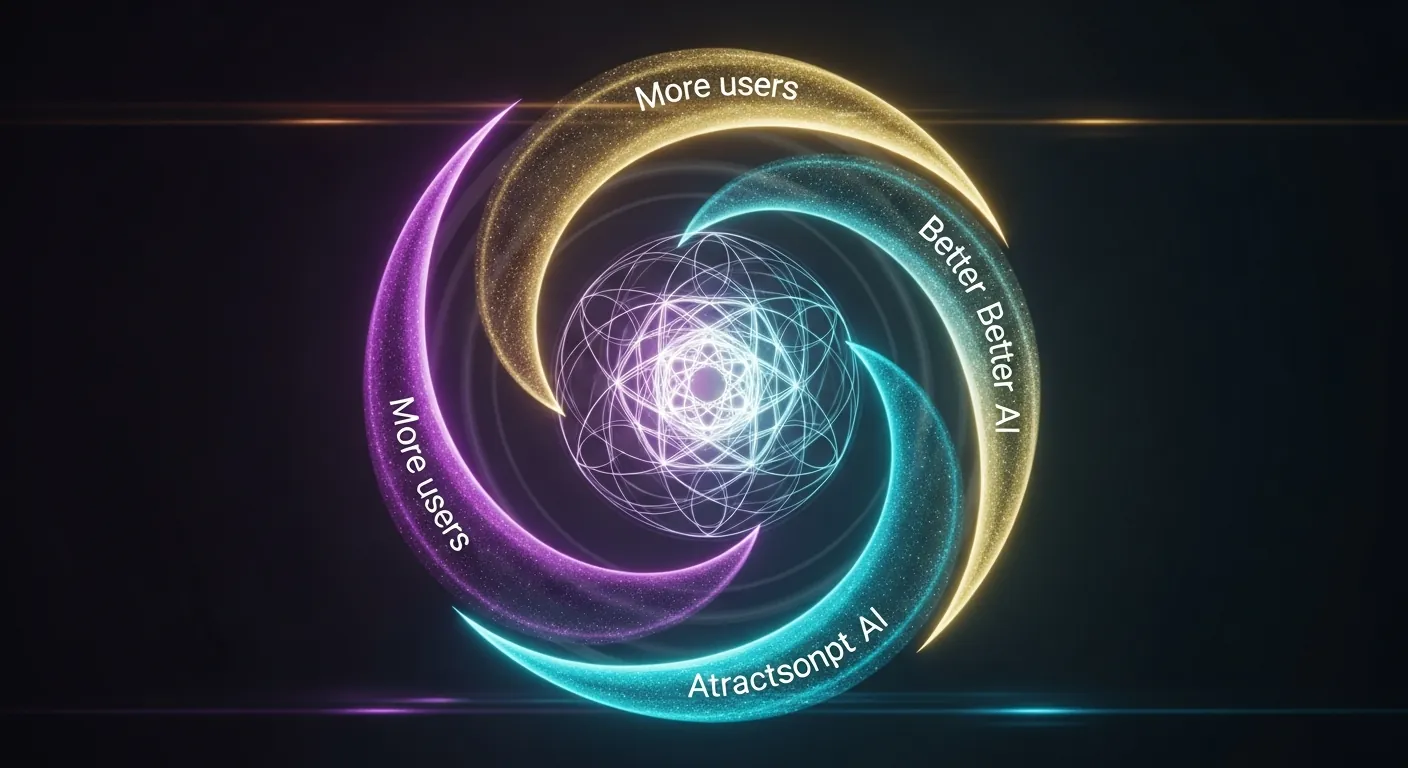
See how the pieces connect
In the proposal, each step in the Flywheel would feed the next, with no beginning and no end, only acceleration.
Six steps, one unstoppable cycle
Contribute Hardware
In the proposal, it would start with something you already own: a laptop, a desktop, a spare server. Connected to the proposed One People network, your idle computing power would join a collective engine serving the community. No special equipment would be required; any device could participate.
Power AI Computation
In the proposal, your hardware would become part of a distributed supercomputer. Together, thousands of individual machines could form an AI infrastructure that rivals anything built by Big Tech. The network would coordinate automatically, routing tasks to the right hardware at the right time, turning scattered devices into a unified force.
Execute Commons Jobs
In the proposal, the community would decide what matters. Through the Commons, people would propose projects: a mental health chatbot, a climate research model, a language preservation tool. AI agents would pick up the work and execute it on contributor hardware. The community would dream it, the AI would build it, and your machine would power it.
Create Real Value
In the proposal, every completed Commons Job would add something tangible: a new AI specialist that helps real people, a public dataset that advances research, a tool that makes life better for an entire neighborhood. The aim is value that is measurable, lasting and shared.
Cultivate Intelligence
The proposal is to recognize useful hardware, ideas, governance participation, and review work under rules yet to be designed, rather than favoring capital alone. No contribution or benefit rights are currently being offered.
Reinvest and Grow
In the proposal, shared intelligence would create a reason to contribute more. Individuals would upgrade their hardware. Cities would build public compute centers. Organizations would deploy nodes in community spaces. Every reinvestment would make the network more powerful, which would make the AI more capable, which would make the Commons more valuable. The Flywheel would spin faster.
Network effects that would compound
Most systems grow linearly. The proposed Flywheel is designed to grow exponentially, because each dimension of growth would amplify all the others.
More hardware, more capacity
In the proposal, every new device added to the network would increase total AI capacity. More capacity would mean the network could take on bigger, more ambitious Commons Jobs. Bigger jobs would attract more contributors who want to take part, which would add more hardware. Supply would create its own demand.
More AI, more valuable work
As AI capacity grew, the proposed network could train more powerful specialists, tackle harder problems and serve more people at once. A network that could build a world-class medical AI would be vastly more valuable than one that can only answer trivia. Quality attracts ambition.
More value, more incentive
The design: if the Commons produced tools that genuinely improve lives, demand for shared intelligence would rise; more valuable intelligence would raise the incentive to contribute hardware; more hardware would grow AI capacity. The loop would close, tighter and faster with every revolution.
A self-sustaining economy of flourishing
The proposed Flywheel is not a business model. It is an economic system designed to produce one outcome: flourishing for all peoples. The aim is that, at critical mass, the network would no longer depend on any single company, investor, or government to keep running. It would sustain itself through the collective contributions of everyone who participates.
In the proposal, cities would become compute hubs, providing AI tools to citizens like a digital commons. Neighborhoods would own their AI infrastructure the way they own their parks and libraries. Individuals would cultivate real intelligence for sharing resources they already have. And the AI that emerged from this network would serve the people who built it, not the shareholders of a distant corporation.
This is what would happen if the means of production were in the hands of the people: not chaos, not inefficiency, but a system where contribution would create flourishing, and flourishing would inspire more contribution.
The aim is a network that builds itself, a community that decides for itself and an economy that sustains itself. One People. One Flywheel. Flourishing for all.
The proposed Flywheel would need you
In the proposal, every revolution of the Flywheel would start with one more person choosing to contribute: their hardware, their ideas, their vote. Join the waitlist to follow the proposal.